Boldwood Shoots Troy at the Christmas Party
Far from the Madding CrowdBoldwood Shoots Troy at the Christmas Party is the violent climax of a gathering where a promise, a return, and a fatal act collide. Boldwood has just secured Bathsheba’s reluctant agreement to wear his ring and begin a secret courtship; Troy’s entrance makes that promise untenable, and Boldwood’s gunfire changes the scene from forced consent to death and attempted suicide.
Causes and Background
Boldwood’s proposal has reached a decisive point. Bathsheba, in tears and with Boldwood still holding her hand, yields to his insistence that she wear the ring that night. She says the six-year courtship and eventual wedding must happen, “since you will have it so,” words that register submission rather than willing affection. Boldwood presses her hand, declares himself happy, and leaves her to recover. The agreement is the immediate expectation that the gathering seems poised to celebrate, but its fragility is already apparent in the contrast between her hopeless whisper and his confidence.
As Bathsheba prepares to leave, the farm workers’ whispered conversation draws attention to news that they fear to disclose. Boldwood asks whether someone has married, become engaged, been born, or died. Laban Tall reports that nobody is dead, while Samway mutters that he wishes somebody were. Their unease anticipates the gathering’s abrupt change, but Boldwood initially treats the exchange as a mystery to be told for amusement. Bathsheba, too, says she does not know what the men mean.
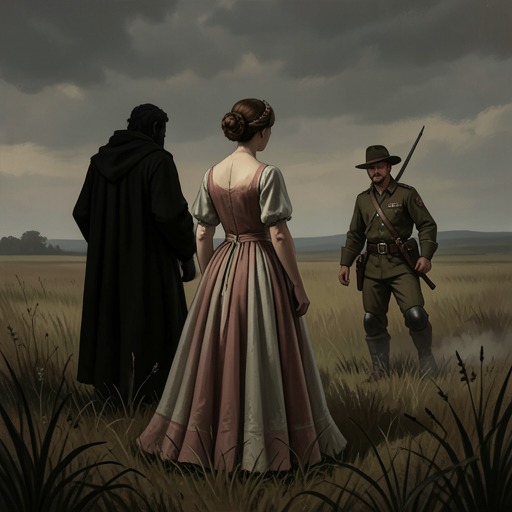
The arrival is announced as that of a stranger wanted by Mrs. Troy. Troy enters wrapped up to his eyes, at first concealing his identity. Boldwood welcomes him and offers him a Christmas beaker, unaware that the visitor is the man whose return can undo the promise he has just extracted from Bathsheba. The gathering’s mistaken welcome intensifies the reversal: Troy is at once a supposed stranger, a recognized threat, and Bathsheba’s husband.
What Happens
Troy advances into the middle of the room, removes his cap, turns down his coat collar, and looks Boldwood in the face. Only then does Boldwood recognize him. Troy turns to Bathsheba and tells her he has come for her and orders her to come home with him. She does not answer. She sinks onto the lowest stair, pale and fixed in place, unable to act; the narration describes her mind as temporarily deprived of light, though she has not fainted.
Boldwood, transformed by despair, tells Bathsheba to go with her husband. Troy crosses to her and repeats his command, then reaches to pull her towards him. She recoils. When Troy seizes her arm and pulls sharply, she gives a quick, low scream. The narrative does not determine whether his grip pinches her or whether his touch itself causes her reaction; the uncertainty keeps the immediate trigger distinct from the accumulated conflict around them.
Boldwood’s response is instantaneous. At the scream, his expression changes, his veins swell, and a frenzied look comes into his eye. He turns to the gun-rack behind him, takes one of its guns, cocks it, and fires at Troy. The blast shakes the oak partition and fills the room with grey smoke. Because the men stand close together, the shot does not spread: it passes into Troy’s body like a bullet. Troy gives a long, guttural sigh, contracts and extends, then lies still.
The killing is not followed by surrender. Boldwood turns to the double-barrelled gun again and prepares to shoot himself, having fastened his handkerchief to the trigger and braced its other end with his foot. Samway sees what he is doing and rushes towards him. Boldwood has already twitched the handkerchief when Samway’s timely blow diverts the second discharge into a beam across the ceiling. The shot misses Boldwood, but he insists that this does not matter and says there is another way for him to die.
Consequences and Aftermath
After the failed suicide attempt, Boldwood breaks away from Samway, crosses to Bathsheba, and kisses her hand. He puts on his hat, opens the door, and goes out into the darkness; no one thinks to stop him. The gesture offers no repair for the violence or comfort to Bathsheba. Instead, it closes the immediate scene with Boldwood leaving the gathering under the shadow of a killing and an unresolved intention to die.
The scene overturns the terms of the promise made only moments earlier. Bathsheba’s consent to the ring had been obtained through Boldwood’s persistence, and Troy’s arrival forces her to confront the husband she had not expected to see there. Her inability to respond and her recoil from Troy are observable; the narrative does not give her words or an explanation in the instant before the shooting. Boldwood acts where Bathsheba cannot, but his intervention is lethal: the gunshot does not restore her freedom or resolve the competing claims upon her, it kills Troy and draws Boldwood toward self-destruction.
The Christmas gathering’s ordinary social setting makes the reversal especially stark. Its workers had been whispering over news, its host had invited a stranger to share a beaker, and Bathsheba had been readying herself to leave. In a few moments, recognition, an order to return home, a scream, and two gunshots replace festivity. The gun-rack, an ordinary feature of a farmhouse, becomes the instrument of the scene’s decisive change, while the missed second shot leaves Boldwood alive to face the consequences of the first.